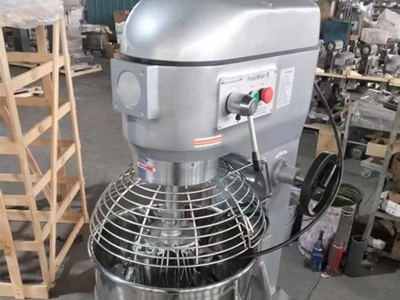
Planetary mixers are named for their unique planetary motion trajectory. This design allows the mixing blades to rotate on their own axis while simultaneously revolving around the container, creating a three-dimensional mixing effect. Compared to traditional mixers, this motion method mixes materials more evenly and reduces dead zones. In practical applications, a typical planetary mixer can process approximately 1.5-2 tons of medium-viscosity materials per hour, with the exact figure depending on the material characteristics and mixing speed.
Key Parameters Affecting Efficiency
Speed Selection: Different materials require different speeds; too high a speed increases energy consumption, while too low a speed negatively impacts mixing efficiency.
Blade Design: Scraper blades effectively prevent material from sticking to the walls, improving mixing uniformity.
Volume Matching: Efficiency is highest when the load is controlled at 60%-80% of the volume.
Temperature Control: Some materials require heating and mixing; temperature control accuracy affects the final mixing quality.
Practical Suggestions for Improving Efficiency
Regular maintenance is fundamental to maintaining high-efficiency operation. Check seal wear weekly and change lubricating oil quarterly. During operation, carefully observe the ammeter reading; abnormal fluctuations often indicate a decrease in efficiency. For special materials, consider custom-made mixing paddles. It is worth noting that it is recommended to stop and cool the machine after 4 hours of continuous operation. This will protect the equipment and maintain stable long-term operating efficiency.