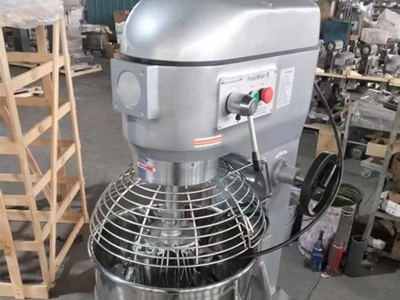
A planetary mixer is a highly efficient mixing device that achieves uniform mixing of high-viscosity materials through a unique planetary motion mechanism. It combines revolution and rotation into a single motion trajectory, making it suitable for handling high-viscosity materials in industries such as chemical, food, pharmaceutical, and battery manufacturing.
Working Principle: The planetary mixer uses a mixing blade that revolves around the vessel's axis while simultaneously rotating on its own axis, creating a complex motion trajectory. This combined motion subjectes the material to intense shearing and kneading, achieving highly efficient mixing. Its efficiency is typically several times that of ordinary mixers, and it is particularly suitable for materials with viscosities ranging from 10,000 to 1,000,000 CP.
Basic Structural Components: The planetary mixer mainly consists of the following core components:
Mixing Blade System: Includes low-speed mixing blades (such as multi-bladed, spiral, or frame blades) and a high-speed dispersion disc, used to achieve macroscopic mixing and microscopic dispersion of materials.
Wall Scraper: Automatically scrapes away material adhering to the vessel wall, reducing residue and improving mixing uniformity.
Planetary gear reducer: As the main drive system, it provides low-noise, high-mechanical-efficiency power transmission, saving space and energy.
Mixing tank: Typically equipped with a jacketed temperature control system, supporting cooling or heating to adapt to different process requirements.
Agitator: Through a combination of revolution and rotation, it achieves shearing and kneading of materials, ensuring uniform mixing of high-viscosity materials.
Wall scraper: Automatically cleans the tank wall, preventing material accumulation, improving mixing efficiency and reducing waste.
Planetary gear reducer: Provides stable power output, ensuring the composite motion trajectory of the agitator while reducing noise and energy consumption.
Jacketed temperature control system: By adjusting the temperature, it meets the mixing process requirements of different materials, such as reaction or dispersion processes.