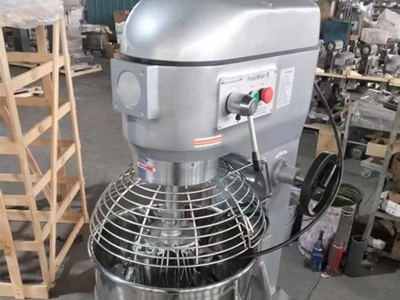
Planetary mixers, through their structural design and functional configuration, can flexibly adapt to the mixing needs of materials with varying viscosities.
Firstly, in terms of the mixing structure, they are equipped with replaceable impellers. For low-viscosity materials, impellers with smaller blade areas and higher rotational speeds, such as propeller-type impellers, are selected to quickly move the material and improve mixing efficiency. For medium- to high-viscosity materials, impellers with larger blade areas and higher strength, such as frame-type and anchor-type impellers, are selected to enhance the shearing and compressing capabilities of the material and prevent material stagnation.
Secondly, the equipment features a wide-range speed regulation function. Through a variable frequency speed control system, the mixing speed can be adjusted according to the material viscosity. High-speed mixing is used for low-viscosity materials to accelerate the mixing process; low-speed mixing is used for high-viscosity materials to prevent motor overload while ensuring thorough mixing.
Furthermore, some units are equipped with a lifting mechanism to adjust the distance between the impeller and the mixing tank. When mixing high-viscosity materials, the impeller position is lowered to be closer to the bottom of the tank, reducing material residue at the bottom; when mixing low-viscosity materials, the impeller position is raised to prevent excessive splashing. In addition, the inner wall of the mixing tank is smooth, and with the wall scraping device, it can effectively deal with the problem of viscous materials sticking to the wall, ensuring that materials of different viscosities can be mixed evenly, and the mixing effect will not be affected by the difference in material viscosity.